
What goes into building a successful brand?

Most people think branding starts with a logo. In reality, a logo is closer to the end of the process than the beginning. By the time I am drawing anything, weeks of research, strategy, and decision-making have already happened.
That upstream work is what makes the difference between a brand that succeeds and one that just looks okay. This is a breakdown of how I approach building a brand from the ground up, and why each stage matters.
1. Discovery & competitive audit
Before anything else, I need to understand the landscape your business operates in. That means looking carefully at your competitors: what they look like, how they talk, what they emphasize, and where they fall short.
This is not about copying what works. It is about understanding the visual and verbal conventions of your category so we can decide, deliberately, where to follow them and where to break from them. In some industries, looking too different from competitors creates distrust. In others, standing out is the whole point.
I also look at your audience. Who are your customers, what do they care about, and what do they respond to? On Kaua’i, this often means understanding the difference between what resonates with locals and what appeals to visitors, and whether your business needs to speak to both or just one.
Market research gives every subsequent decision a foundation. Without it, brand design is guesswork.
2. Brand strategy
Strategy is where we answer the fundamental questions about your brand before we touch any visuals. This is often the most valuable part of the process, and the part most people want to skip.
The questions we are working through in this phase include:
- What does this business do, and who is it for?
- What are the core values that should guide every decision, from the design to the customer experience?
- What is the brand personality? If this business were a person, how would they speak and behave?
- What promise does this brand make to its customers, and can it keep it?
- What is the brand's reason for existing beyond making money?
The output of this phase is a strategy document that every visual decision will be measured against. When a color choice or a font feels off later in the process, the strategy is what tells us why.
3. Positioning
Positioning is a specific output of the strategy phase that deserves its own attention. It answers one question: where does this brand live in the minds of its customers, relative to everything else they could choose?
A positioning statement is not a tagline. It is an internal tool, a precise articulation of who you serve, what you offer, why it matters, and why you are the right choice. It shapes the tone of your copywriting, the feeling of your visuals, the price point you communicate, and the customers you attract.
Good positioning is specific. "High quality food for people who care about ingredients" is not positioning. "The only cafe on the South Shore that sources every ingredient from Kauai farms" is positioning. One says something that could apply to anyone. The other draws a line.
4. Stylescapes
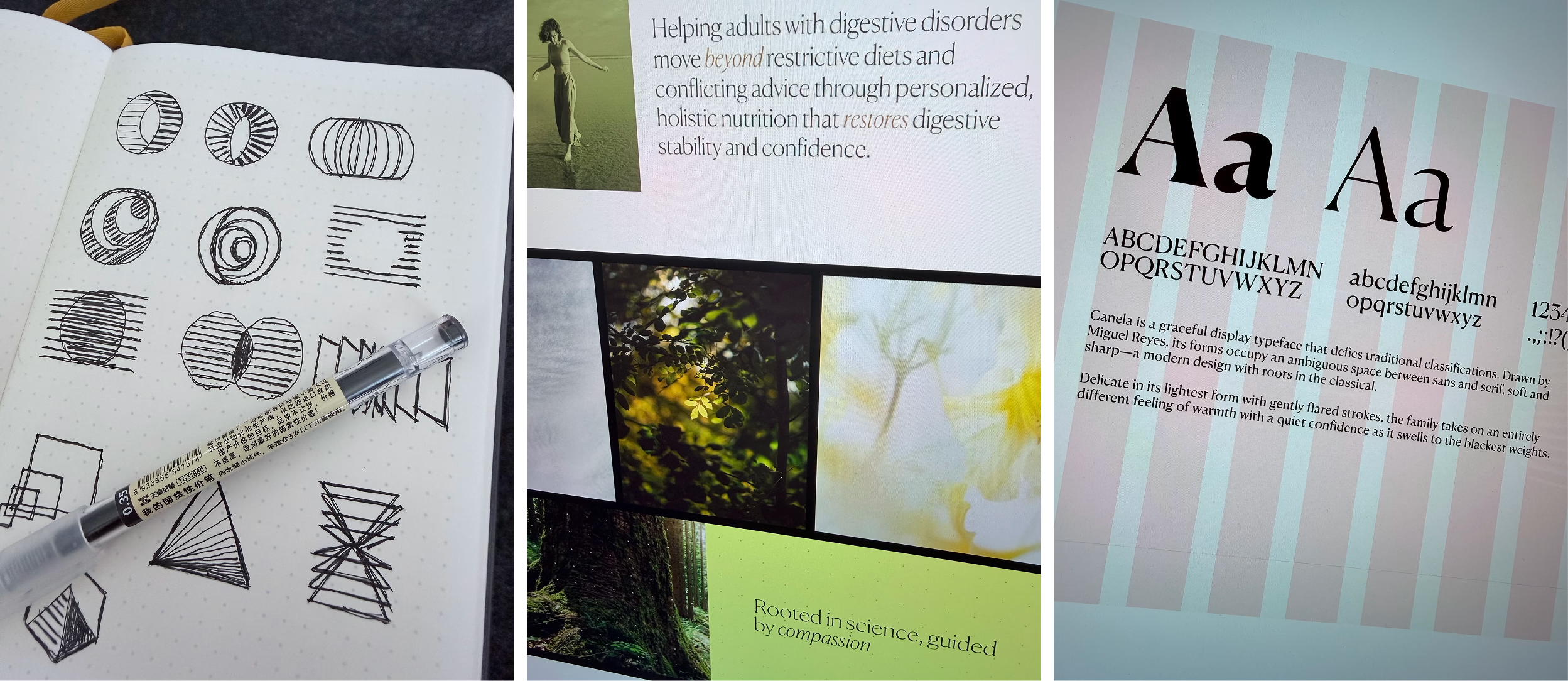
This is where the work starts to become visual, but we are not designing yet. A stylescape is a curated collection of imagery, textures, type, color, and reference material that communicates a visual direction before a single original element has been created.
Think of it as a hypothesis. Based on everything we have established in strategy and positioning, this is the visual world this brand should live in. Stylescapes let us pressure-test that hypothesis with you before we invest time in actual design work.
I typically present two or three distinct directions, each pulling in a different but defensible creative interpretation of the strategy. This is not about giving you options to pick your favorite. It is about finding the direction that resonates most deeply with who your business actually is.
Getting alignment at this stage saves significant time later. It is much easier to change direction on a stylescape than on a fully developed logo system.
5. Brand identity design
Now we design. With a clear strategy, strong positioning, and an approved visual direction, the identity design phase has a brief that actually means something.
A full brand identity typically includes:
- Logo system. Primary logo, secondary variations, and a simplified mark that works at small sizes and in single color applications like embroidery or stickers.
- Color palette. A primary palette and supporting colors, with specific values for print and digital use.
- Typography. A type system with clear hierarchy: headline fonts, body fonts, and rules for how they work together.
- Supporting elements. Patterns, textures, iconography, illustration style, or photography direction depending on the scope of the project.
- Brand voice. Tone of voice guidelines that define how the brand communicates in writing across every context.
Each element is designed to work both independently and as part of a cohesive system. A logo that only works on a white background is not a complete logo. A color palette that falls apart in print is not a complete palette.
6. Brand guidelines
Once the identity is approved, everything gets documented. Brand guidelines are the rulebook that keeps your brand consistent over time, regardless of who is applying it.
This document covers how to use every element of the identity correctly: minimum logo sizes, color values for every context, type hierarchy in practice, what to do and what to avoid. It is what you hand to a printer, a web developer, a social media manager, or a sign maker so that every touchpoint looks like it came from the same place.
Good guidelines are practical, not just pretty. They anticipate the real situations your brand will encounter and give clear direction for each one.
7. Launch & support
A brand launch is not the finish line. It is the beginning of the brand actually doing its job in the world, and that transition from document to reality is where things can go sideways without the right support.
Once the identity is ready, I work with clients to roll it out across the touchpoints that matter most for their business. For a new business on Kaua’i, that usually means a website, social campaigns, and physical signage, packaging or print collateral. The priority depends on where your customers encounter you first, and we make those decisions together.
But the work does not stop at launch. Brands grow. Businesses add products, open new locations, hire staff, run campaigns, and encounter situations nobody anticipated during the design phase. Having someone who built the brand from the ground up available to help navigate those moments is worth a lot more than a folder of files and a handshake.
I stay available to clients after every project. Whether that means designing a new piece of collateral, advising on how to extend the brand into a new context, or just answering a quick question about whether something looks right, that ongoing relationship is something I take seriously. A brand is a long-term investment, and I treat it like one.
Why the process matters
Every stage in this process exists because skipping it creates a problem downstream. Skip the research and you design in a vacuum. Skip the strategy and the visuals have nothing to say. Skip the stylescape and you might spend weeks designing something that goes in the wrong direction. Skip the guidelines and the brand falls apart the moment someone else touches it.
A brand built this way takes longer and costs more than a logo from a template site. It is also something that will still be working for your business in ten years.
That is the difference between decoration and design.

Kerry Nehil is a brand designer based in Kalaheo, Kaua'i. He works with small businesses across the island to build brands that are strategic, distinctive, and built to last.
More insights

Behind the brand: Kobi Yasutake
A collaboration resulting in a meaningful brand that avoids clichés.
Starting a small business on Kaua’i? Begin with your brand.
How to make an informed decision when taking the critical step of branding your business on Kaua'i.

How to find a brand designer on Kaua’i
What to look for when you're ready to grow your business.